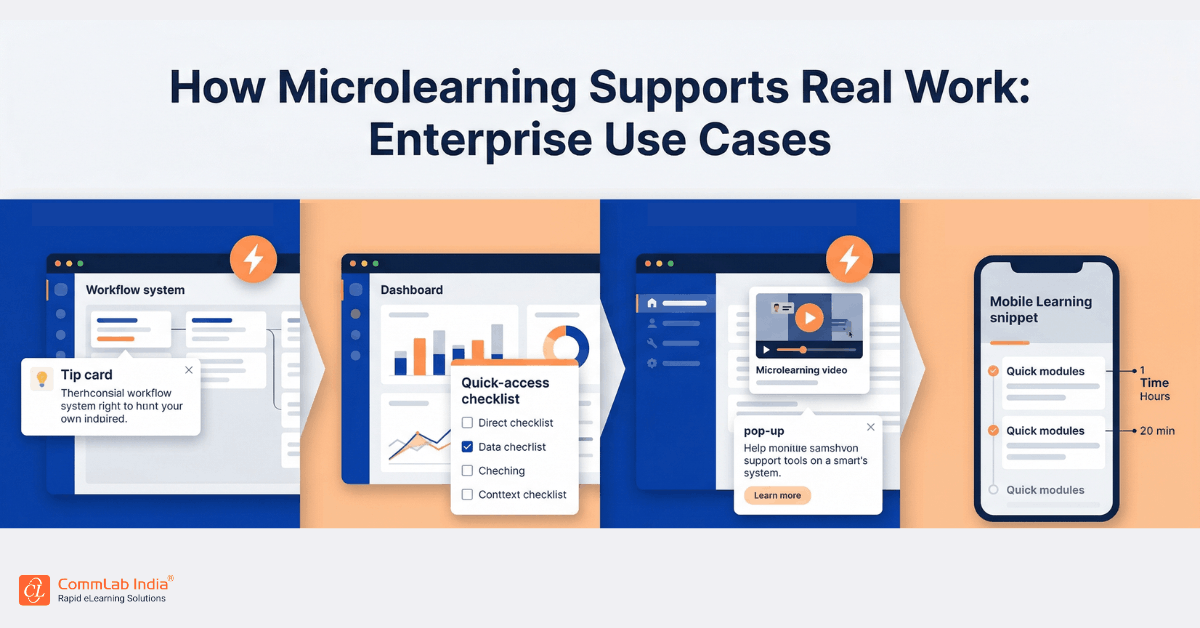
Microlearning becomes far more persuasive when it moves out of theory and into work.
That is often where many L&D conversations begin to change. At a conceptual level, microlearning is easy to appreciate. It is flexible, focused, easier to consume, and often better aligned with the pace of work than traditional long-form training. But those advantages only become meaningful when organizations can see how microlearning solves real training problems across real roles, real workflows, and real business contexts.
When designed well, microlearning can support learning before, during, and after formal programs. It can help employees prepare for work, perform during work, and reinforce learning after work. It can support fast-moving business needs, role-specific workflows, and recurring training challenges that larger courses often struggle to address efficiently.
This article explores where microlearning fits across the enterprise, how it supports different learner groups, why it is especially useful in high-change environments, and how L&D teams can use it to strengthen performance support rather than merely shorten training.
Download Now: Microlearning — Where Does It Fit in Your Learning Strategy?
Table of Contents
- How Microlearning Supports Performance Across Different Workforce Contexts
- Microlearning for Onboarding and Early Role Readiness
- Microlearning for Sales Enablement and Field Readiness
- Microlearning for Compliance and Safety Training
- Microlearning for Refresher Learning and Knowledge Retention
- Microlearning for Software Training, Product Adoption, and Customer Enablement
- Microlearning for Technicians, Service Roles, and Frontline Execution
- Microlearning as Performance Support in the Flow of Work
- FAQs
How Microlearning Supports Performance Across Different Workforce Contexts
One reason microlearning continues to grow in relevance is that it can support very different kinds of work without losing its instructional value. That adaptability is especially important in enterprise environments, where a single organization may need to train office-based employees, field teams, sales representatives, managers, technicians, customer-facing staff, and newly hired employees across multiple systems and business units.
What changes across these groups is not the basic logic of microlearning, but the way it is applied.
For some employees, microlearning functions as a readiness tool that helps them enter a role more confidently. For others, it acts as a performance support layer that helps them act correctly during a task or customer interaction. In other cases, it provides reinforcement after formal learning so critical information is not forgotten as soon as the course ends.
This is what makes microlearning especially powerful in enterprise learning strategy. It can adapt to:
- different time pressures
- different levels of task complexity
- different patterns of learner access
- different device and location realities
- different reinforcement needs
Microlearning across workforce contexts
| Workforce Context | Primary Microlearning Value | Typical Use |
| New hires | Faster readiness and lower onboarding overload | Orientation, systems support, role reminders |
| Sales teams | Mobile, timely reinforcement and product readiness | Objection handling, feature refreshers, coaching support |
| Compliance-sensitive roles | Frequent recall and decision reinforcement | Policy scenarios, reminders, risk awareness |
| Safety-critical roles | Short, repeated behavior reinforcement | Hazard awareness, procedural steps, prevention reminders |
| Technicians and frontline teams | Point-of-need task support | Troubleshooting, repair steps, equipment guidance |
| Customer-facing teams | Fast access to product and interaction guidance | Product updates, service quality support, response standards |
The more dynamic the work environment, the more valuable this kind of focused learning support becomes. Employees rarely need more content simply because it exists. They need the right learning intervention at the right time, in a format that makes action easier rather than harder.
That is why enterprise microlearning works best when it is shaped by the realities of the workforce, not by a generic content model applied uniformly to everyone.
Microlearning for Onboarding and Early Role Readiness
Onboarding is one of the strongest and most practical use cases for microlearning because it addresses a problem many organizations still underestimate: new hires are often overwhelmed long before they become capable.
Traditional onboarding tends to be information-heavy, front-loaded, and disconnected from the actual rhythm of early role performance. New employees are given policies, systems, expectations, tools, introductions, and job responsibilities in dense blocks that assume retention will follow exposure. In reality, much of that information is forgotten before it becomes useful.
Microlearning helps solve this by spreading support across the early employee journey rather than concentrating it in the opening days alone.
Instead of asking new hires to absorb everything at once, organizations can use microlearning to:
- introduce key concepts in smaller, more manageable units
- reinforce critical information after initial orientation
- support role-specific tasks as they emerge
- provide quick reminders during the first weeks of real work
- reduce cognitive overload while improving readiness
This is especially important because onboarding is not only about helping people understand the organization. It is about helping them become functional, confident, and productive in their role.
Where microlearning adds the most value in onboarding
- Before day one
Short pre-boarding assets can introduce culture, expectations, key contacts, or administrative essentials. - During orientation
Microlearning can break up dense formal content and reinforce critical knowledge without overwhelming new hires. - During early role performance
Quick-reference tools, short walkthroughs, and role-based prompts help employees perform tasks as they encounter them. - After structured onboarding ends
Reinforcement assets help maintain momentum when formal onboarding support fades but real learning still continues.
Microlearning is particularly effective in onboarding because it respects the fact that readiness develops over time. New hires do not need every answer immediately. They need the right support at the right stage.
That is a more realistic and more humane model of onboarding, and it usually leads to stronger retention and faster confidence in role execution.
Microlearning for Sales Enablement and Field Readiness
Sales is one of the clearest examples of where microlearning aligns naturally with work.
Sales teams operate in fast-moving, high-pressure environments where product details change, customer objections vary, conversations are dynamic, and time for formal learning is limited. In this context, long training events can still play an important role, especially for foundational knowledge and selling frameworks, but they are rarely enough by themselves. What sales teams often need in the flow of work is targeted reinforcement, rapid access to product knowledge, and just-in-time support before or between customer interactions.
That is precisely where microlearning becomes valuable.
When used well, microlearning helps sales professionals:
- refresh product features quickly
- reinforce key messaging and positioning
- review objection-handling approaches
- stay current on new product updates
- prepare for specific conversations or account types
- revisit critical knowledge without leaving the workflow for long periods
This makes microlearning particularly useful for mobile sales teams, distributed field forces, and industries where product information changes frequently, such as pharma, technology, or complex B2B environments.
Why microlearning works especially well for sales
- It matches the pace of the role
Sales teams often have small windows for learning, not long uninterrupted periods. - It supports repetition without fatigue
Product details and messaging often need to be refreshed repeatedly, especially when offerings evolve. - It helps bridge training and customer interaction
Learning is most valuable when it can be accessed just before use. - It supports a blend of knowledge and behavior
Sales success depends both on knowing and on responding well in real situations.
High-value sales use cases for microlearning
- product feature refreshers
- mobile learning for field reps
- sales conversation models
- objection-handling practice
- launch support for new offerings
- reinforcement after formal sales training
- role-based coaching prompts
Sales enablement is a strong example of how microlearning can move beyond course delivery and become an ongoing support layer for performance. The more directly it is tied to the moments sales teams actually prepare, engage, and follow up, the more valuable it becomes.
Microlearning for Compliance and Safety Training
Compliance and safety are often treated as separate training categories, but from a microlearning perspective, they share an important characteristic: both require more than completion. They require recall, judgment, and behavior under real-world conditions.
That is why these are such important use cases.
Traditional compliance and safety training often relies too heavily on one-time course completion. Employees are expected to retain critical rules, identify risks, and behave correctly long after the formal training has ended. But high-stakes recall rarely improves through information exposure alone. It improves through repeated reinforcement, practical context, and timely reminders that keep key decisions visible.
Microlearning supports this far better than many traditional approaches because it allows organizations to revisit critical concepts in smaller, focused intervals.
In compliance training, microlearning can support:
- policy clarification
- scenario-based decision practice
- reminders about common risk areas
- role-specific examples of correct and incorrect behavior
- refresher learning after annual compliance programs
In safety training, microlearning can support:
- hazard recognition
- procedural reminders
- equipment handling steps
- near-miss prevention awareness
- reinforcement of safe habits and routines
These use cases are especially valuable because compliance and safety are not purely knowledge problems. They are performance problems. Employees need to recognize cues, respond correctly, and remember what matters under real conditions.
Why microlearning strengthens compliance and safety outcomes
- It helps convert training into repeated exposure
Critical information is more likely to be remembered when revisited over time. - It makes high-risk topics easier to reintroduce
Instead of waiting for annual cycles, organizations can reinforce issues more continuously. - It supports contextual judgment
Short scenarios and practical reminders help employees connect policies to real decisions. - It fits well with behavior reinforcement
Many safety and compliance habits improve when learning appears close to the point of action.
Microlearning does not replace formal compliance or safety programs, especially in regulated or high-risk contexts. But it significantly improves them when used as a reinforcement and performance support layer around the core training experience.
Microlearning for Refresher Learning and Knowledge Retention
One of the most practical uses of microlearning is also one of the most overlooked: helping people remember what they have already learned.
This matters because training often fails quietly after completion. Employees finish a course, pass an assessment, and then gradually lose recall because there is no structured reinforcement after the event. In many organizations, this learning decay is accepted almost as a normal condition of training. Yet it creates serious inefficiencies. Teams have to retrain, repeat, or intervene later because the original learning was never sustained effectively.
Microlearning is particularly strong in this space because it can reintroduce key ideas in manageable, low-friction ways over time.
Refresher learning is where microlearning often delivers some of its clearest value because it supports:
- spaced reinforcement
- recall activation
- quick revisiting of essential ideas
- just-in-time knowledge refresh before task performance
- lower-cost support than full retraining
Common refresher use cases for microlearning
- revisiting key compliance rules
- refreshing product knowledge before campaigns or launches
- reinforcing customer service standards
- sustaining onboarding knowledge after the first month
- revisiting process steps after system changes
- strengthening retention after classroom or virtual training
Why refresher learning is such a natural fit
- The content is already familiar
Learners do not need a full explanation again. They need a well-timed reminder or retrieval cue. - The time requirement is low
Refreshers are most effective when they feel easy to engage with rather than burdensome. - The value is cumulative
A sequence of focused refreshers often produces better retention than one isolated review session.
Microlearning is especially effective here because refresher learning should not feel like starting over. It should feel like regaining sharpness. Short, timely learning assets are uniquely well suited to that role.
Microlearning for Software Training, Product Adoption, and Customer Enablement
Software training and product adoption are high-value use cases for microlearning because both involve recurring change and repeated need for support.
Employees rarely struggle with software or product changes because they are incapable of learning them. They struggle because the learning is often delivered too early, too broadly, or too far away from the actual moment of use. Large product rollouts and systems training programs frequently overload learners with information they cannot immediately apply, which makes retention weak and adoption slower than expected.
Microlearning helps reduce that problem by offering smaller, more practical learning support aligned to real usage.
For software training, microlearning can support:
- guided walkthroughs of key tasks
- short demonstrations of specific features
- step-based process reminders
- troubleshooting support
- reinforcement after systems training sessions
For product adoption, it can support:
- launch communications
- role-based product explainers
- quick videos on feature use
- adoption nudges
- support for internal teams who must explain or use the new product
For customer training, it can support:
- onboarding into a platform or service
- short product education moments
- feature-use guidance
- change communications for new releases
- self-service enablement
These are especially strong use cases because learners often need support in small doses, close to the moment of action. They do not always need a long course. They need clarity, confidence, and a fast path to correct use.
Why microlearning strengthens adoption
- It lowers friction for users
Learners can access support without stepping out of work for long periods. - It improves relevance
Content can be tied to specific tasks, updates, or roles instead of being delivered as a broad overview. - It supports ongoing change
Product and software environments evolve, and microlearning makes updates easier to communicate and reinforce.
In these settings, microlearning acts less like a standalone course and more like an adoption accelerator. That is a highly strategic role for L&D.
Microlearning for Technicians, Service Roles, and Frontline Execution
Some of the strongest performance-support use cases for microlearning appear in technical and frontline environments, where employees must complete tasks accurately, often under time pressure, with limited room for error.
Technicians, service professionals, and frontline workers often operate in settings where long learning interventions are impractical once work begins. What they need instead is focused support that helps them recall a procedure, diagnose a problem, confirm a step, or access guidance without disrupting task flow.
This is where microlearning becomes especially useful because it can live close to the work itself.
High-value use cases in technical and frontline roles
- repair and troubleshooting support
- equipment operation reminders
- process step verification
- service procedure refreshers
- safety and quality reinforcement
- mobile task support for field teams
The key difference in these contexts is that learning is often inseparable from execution. Employees do not simply need to know. They need to perform correctly, sometimes immediately.
Why microlearning works well for technicians and frontline teams
- It supports mobile access
Many frontline environments require content that can be accessed quickly on the move. - It reduces memory burden
Workers do not have to rely entirely on recall when critical guidance is available at the point of need. - It improves consistency
Standardized microlearning assets help reinforce best practice across dispersed teams. - It helps bridge training and task execution
Learning remains useful because it is close to the moment where errors or uncertainty are most likely.
These roles highlight a broader truth about microlearning: its value is often highest when the work environment is fast, variable, distributed, or operationally demanding.
Microlearning as Performance Support in the Flow of Work
Perhaps the most strategically significant application of microlearning is performance support.
This is where microlearning moves beyond course design and becomes part of how work is done. Instead of asking learners to stop working in order to learn, performance-support-oriented microlearning brings learning closer to the moment of need. It helps people act, decide, remember, or confirm something while the work is still happening.
That is a major shift in learning design.
In traditional training models, learning and performance are often separated. Employees attend training, return to work, and are expected to transfer what they remember. In performance support models, that transfer burden is reduced because part of the support is available during execution.
Microlearning as performance support can take many forms:
- quick-reference tools
- short process reminders
- task walkthroughs
- scenario-based decision prompts
- product or system refreshers
- troubleshooting assets
- short videos showing one critical action or behavior
The important point is not the format alone. It is the timing and function. Performance-support microlearning is designed to reduce hesitation, uncertainty, and error at moments where action matters.
Why performance support is such a strong strategic application
- It aligns learning with work rather than separating them
- It reduces the need for perfect memory in complex environments
- It supports faster execution and better consistency
- It improves the usefulness of learning investments over time
This is often where microlearning becomes most valuable to the business because it contributes not only to learning outcomes, but also to execution quality, efficiency, and risk reduction.
A practical performance-support lens
When considering a microlearning opportunity, ask:
- Is this a moment where the employee needs to remember something critical?
- Would short-form support reduce delay, confusion, or error?
- Is the need recurring enough to justify a reusable support asset?
- Can the learning be embedded close to the task or decision itself?
If the answer is yes, microlearning may be functioning less as training content and more as a performance enabler. That is often where its highest value lies.
FAQ
1. What are the best business use cases for microlearning?
A. The strongest business use cases for microlearning include onboarding, sales enablement, compliance training, safety reinforcement, refresher learning, software training, product adoption, customer education, technician support, and point-of-need performance support. These areas benefit because learners need focused guidance that can be accessed quickly and applied immediately.
2. How is microlearning used in onboarding?
A. In onboarding, microlearning helps reduce overload by spreading support across the early employee journey. It can prepare new hires before day one, reinforce key information during orientation, support role-specific tasks during the first weeks, and sustain learning after formal onboarding ends.
3. Why is microlearning effective for sales training?
A. Microlearning works well for sales because it supports mobile access, frequent reinforcement, product refreshers, objection handling, and quick preparation before customer interactions. It fits the pace of sales work and helps teams revisit important knowledge without long breaks from the field.
4. How does microlearning improve compliance and safety training?
A. Microlearning improves compliance and safety training by reinforcing critical knowledge over time, supporting better recall, and helping employees apply policies or safety behaviors in real contexts. It is especially useful for reminders, short scenarios, procedural reinforcement, and behavior-focused refreshers.
5. What is microlearning performance support?
A. Microlearning performance support refers to short, focused learning assets that help employees act correctly while work is happening. These assets may include quick-reference tools, walkthroughs, short videos, or reminders that reduce uncertainty, improve accuracy, and support faster execution.
6. Can microlearning be used for technicians and frontline workers?
A. Yes. Microlearning is highly effective for technicians and frontline roles because it supports mobile, point-of-need access to task guidance, troubleshooting help, repair steps, process reminders, and safety reinforcement. It helps workers perform accurately without relying only on memory.
7. How should organizations plan microlearning use cases?
A. Organizations should plan microlearning around recurring workforce needs such as readiness, reinforcement, adoption, execution, and enablement. This helps L&D teams prioritize high-value applications and build a more consistent, scalable approach instead of responding to isolated requests.
Conclusion
Microlearning proves its real value when it is tied to work, not just to content design.
Onboarding, sales enablement, compliance, safety, refresher learning, software adoption, customer training, technician support, and workflow performance are not random applications. They are recurring enterprise contexts where employees need focused, timely, and practical support. When microlearning is applied thoughtfully in these settings, it does far more than make training shorter. It makes learning more usable.
For L&D teams, the opportunity is not simply to create more applied examples. It is to build a clearer enterprise use-case strategy that aligns microlearning with readiness, retention, adoption, and performance across the workforce.
That is how microlearning moves from concept to capability. And that is where its business impact becomes easiest to see.