Corporate training is under unprecedented pressure. Skills are changing faster than traditional learning programs can keep up. Research indicates that nearly 29% of the global workforce will require upskilling to remain effective in their current roles, while another 19% will need reskilling to transition into new roles as technology and automation reshape work.
At the same time, engagement in the workplace remains a major challenge. According to Gallup, employee disengagement costs the global economy approximately $8.8 trillion in lost productivity each year, equivalent to nearly 9% of global GDP. These realities expose a fundamental weakness in many corporate training programs: employees are often told what to do, but rarely given the opportunity to practice making real decisions.
Scenario-based learning addresses this gap. Instead of presenting information passively, it places learners inside realistic workplace situations where they must make choices, experience consequences, and refine their judgment. When combined with branching logic in tools like Articulate Storyline, this approach transforms training into decision practice rather than content consumption.
For organizations navigating rapid skill change, scenario-based training offers a powerful way to help employees build the critical thinking and situational judgment needed to perform effectively in complex, real-world environments.
In this article, you’ll learn how scenario-based branching training works and why it is one of the most effective approaches for developing real-world decision skills. You’ll also explore practical steps to design and build interactive scenarios using Articulate Storyline.
Download eBook Now: Rapid eLearning Authoring Tools
Table of Contents
- What is scenario-based learning
- Why scenario-based learning matters in 2026
- The Scenario Architecture Framework
- Step-by-step: Build branching scenarios in Articulate Storyline
- Branching assessments: How to design decision-based quizzes
- Tracking completion in non-linear courses
- Complex interactivities that make scenarios feel real
- Common mistakes and how to avoid them
- Enterprise considerations: Governance, scale, and accessibility
- FAQs
What is scenario-based learning?
Scenario-based learning is a training method where learners practice making decisions in realistic situations, experience consequences, and receive feedback that improves future performance. It is typically built around workplace stories, role-based choices, and branching paths.
Scenario-based learning is practice-based training where learners apply knowledge in realistic work situations. Instead of reading rules, they make decisions, see consequences, and receive feedback. Well-designed scenarios focus on judgment, not recall, and are most effective when they map directly to real job tasks and performance outcomes.
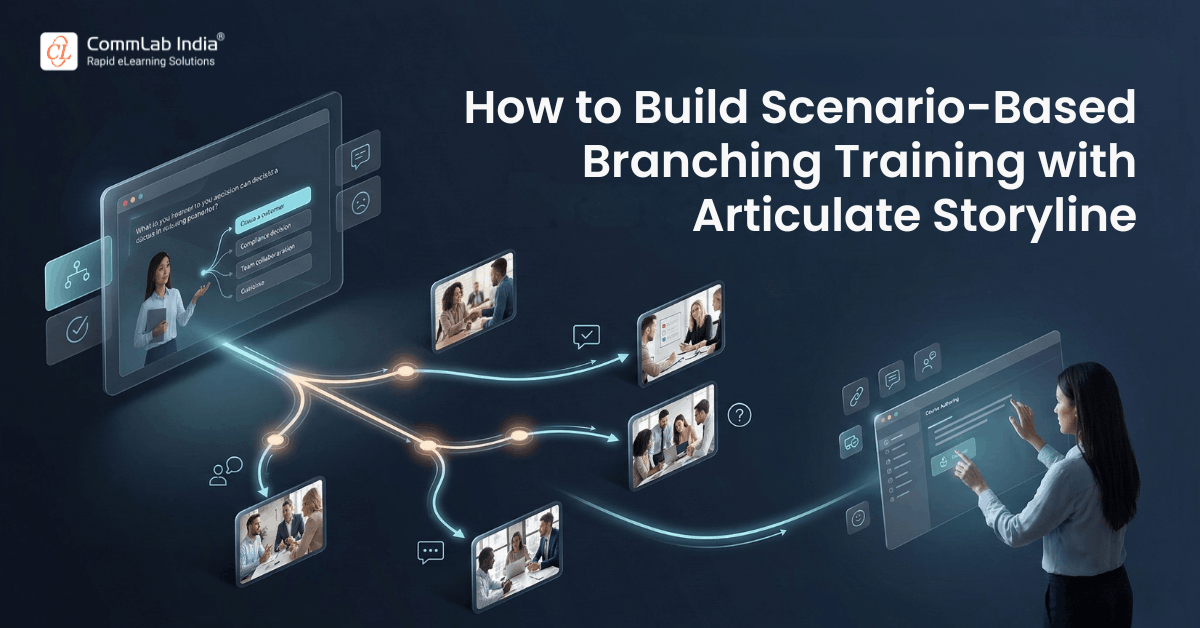
When combined with branching logic in Articulate Storyline, scenario-based learning becomes even more effective. Branching scenarios allow training designers to create interactive learning experiences where each decision leads to a different path, simulating real-world conversations, customer interactions, compliance dilemmas, or operational challenges. Rather than passively consuming content, learners actively practice the decision-making skills they will need on the job.
Why scenario-based learning matters in 2026
Scenario-based learning is becoming essential as the workplace grows more complex and unpredictable. To understand why, it helps to look at three major forces currently reshaping how organizations train and develop employees.
Three forces are colliding:
- Skills volatility is now normal. The World Economic Forum notes that a significant share of workers’ skills will be disrupted in the near term, increasing pressure on L&D to drive faster capability shifts.
- Engagement is not a “nice to have.” Gallup estimates disengagement costs the global economy $8.8 trillion, or about 9% of global GDP. That is a performance and productivity problem, not a culture slogan.
- AI is changing how people learn and work. LinkedIn’s Workplace Learning Report highlights that many organizations are actively responding to skill challenges and evolving learning expectations.
Together, these forces highlight a clear shift in corporate learning priorities. Organizations must move beyond information delivery and focus on learning experiences that build real decision-making capability.
Scenario-based learning is one of the most durable answers because it builds transfer, not just awareness. It helps people do the job, not describe the job.
The key benefits of scenario-based and branching learning include:
- Stronger transfer to real work: Scenarios let learners picture themselves in real situations and build memory links tied to context and consequence.
- Better decisions under pressure: Branching creates a “decision rehearsal” environment: choose, commit, see the impact, adjust.
- Higher engagement without gimmicks: When learners feel the scenario is about them, curiosity and intrinsic motivation rise because progress depends on judgment, not clicking.
- Personalization without rebuilding the entire course: Branching can route different roles to different content paths, which is especially useful when one course must serve multiple audiences.
Evidence from immersive learning research reinforces a key point: practice environments can produce stronger confidence, focus, and learning efficiency than passive formats. For example, PwC reported VR learners were more confident and more focused than comparison groups, and completed training faster in their study context.
You do not need VR to apply the principle. Scenarios in Storyline can deliver the same core advantage: safe practice with consequences.
The Scenario Architecture Framework
If you want scenarios that drive behavior change, design them in layers. Here is a framework that scales across onboarding, sales, leadership, compliance, and product training.
Layer 1: Performance goal
- What should a person do differently after this scenario?
- What does “good” look like on the job?
Layer 2: Triggering context
- What situation reliably produces mistakes or inconsistency?
- What constraints make it hard (time, risk, customer emotion, ambiguity)?
Layer 3: Decision points
- 2 to 4 key decisions per scenario is usually enough.
- Each decision should feel plausible, not obviously right or wrong.
Layer 4: Consequences
- Immediate consequence (what happens now)
- Downstream consequence (what happens later)
- Social consequence (trust, credibility, customer confidence)
Layer 5: Feedback design
Use feedback that teaches judgment:
- What you did
- Why it mattered
- What to do next time
Layer 6: Measurement
Define how you will measure impact:
- Decision quality score
- Time to proficiency
- Error reduction
- Performance metrics (sales outcomes, compliance incidents, customer satisfaction)
A strong scenario includes six elements: a clear performance goal, realistic context, a small set of meaningful decisions, consequences that mirror work, feedback that teaches judgment, and measurement tied to business outcomes. If any element is missing, the scenario may feel engaging but will rarely change real workplace behavior.
Step-by-step: Build branching scenarios in Articulate Storyline
Storyline is effective for scenarios because it supports characters, scenes, trigger-based interactions, branching navigation, and mobile-friendly playback.
Step 1: Map the branching logic before you build
Create a simple branching map:
- Start state
- Decision 1 options
- Consequence paths
- Recovery path (how learners learn and continue)
- End states (success, partial success, failure with coaching)
Design tip: avoid “spaghetti branching.” Rejoin paths after key consequences so the experience stays manageable.
Step 2: Build the cast and set the scene
Storyline includes built-in characters and variations that support fast scenario production. One infographic notes characters in tens of thousands of combinations, with poses and expressions that can be controlled with triggers.
Use characters to signal role and emotion, not decoration:
- Customer frustration
- Manager skepticism
- Peer hesitation
- Stakeholder urgency
Step 3: Create decisions that feel like real work
A good scenario choice:
- has tradeoffs
- reflects real constraints
- requires judgment, not memory
Step 4: Build consequences using layers, states, and triggers
This is where Storyline is strong. You can create trigger-based interactions and interactive decision moments (including controls like dials) that make learners feel agency.
Recommended pattern:
- Decision slide: show the situation and choices
- Consequence layer: show what happens next
- Coaching layer: explain why it mattered
- Return to flow: move forward or retry with context
Step 5: Make it usable on mobile and touch devices
Storyline’s responsive player adapts for tablets and smartphones and supports touch gestures in HTML5 output, including swipe and pinch-to-zoom.
This matters because scenario-based learning often works best in short, repeatable practice sessions.
Branching assessments: How to design decision-based quizzes
Most quizzes test recall. Branching assessments test judgment. Storyline supports assessments where the next question depends on a learner’s selection, using triggers and states.
A practical method for branching questions
A straightforward approach is:
- Build Question 1
- Remove default correct/incorrect layers if you want the branch to control feedback
- Create the next question slides
- Add triggers to route to Question 2 or Question 3 depending on the learner’s answer
Use branching assessments for:
- role-based diagnostics
- experience-based routing
- personality or preference inventories (when appropriate)
- applied decision checks in compliance and sales
A branching assessment is a quiz where each learner’s path changes based on their responses. Instead of one linear sequence, choices route learners to different questions, scenarios, or feedback. In Storyline, this is typically built by removing default quiz layers and using triggers to jump to different slides based on selected answers.
Tracking completion in non-linear courses
Enterprise teams often face this issue: a course has no final quiz, or learners visit only the slides relevant to their role. You still need the LMS to mark completion.
One approach is to use a Result Slide and route learners to it after they complete their assigned branch, even if they did not visit every slide.
The method described includes inserting a blank result slide, setting passing score to 0%, adjusting options, and adding triggers from branch endpoints to the result slide.
Note: Validate your tracking method in your LMS with your chosen standard (SCORM, xAPI, cmi5) and confirm how completion is calculated.
Rapid eLearning Authoring Tools
Explore the What and the Why of Popular Rapid eLearning Development Tools, and GenAI Tools
- Categories of eLearning Authoring Tools
- Considerations to Choose Your Next Authoring Tool
- Features of Popular Rapid Authoring Tools
- GenAI Tools to Create Content, Graphics, Audio, and Video
Complex interactivities that make scenarios feel real
Scenarios become believable when learners can do something that resembles the job.
Storyline supports richer interactions (for example, drag-and-drop, hotspots, and object-level controls) that help create more complex interactivities without needing programming.
Use these strategically:
- Process decisions: choose steps, sequence actions, handle exceptions
- Customer conversations: select responses, then watch tone and trust shift
- Risk identification: click hotspots to find issues in an environment
- Tradeoff simulations: adjust variables (time, budget, quality) and see outcomes
Design rule: Add interactivity only when it increases fidelity to the job.
Common mistakes and how to avoid them
Even well-intentioned scenario-based courses can fail if the design focuses on complexity instead of learning outcomes. Recognizing common design mistakes helps instructional designers build branching scenarios that remain realistic, manageable, and impactful.
Mistake 1: Writing “fake choices”
If one option is obviously correct, it is not practice. It is a disguised multiple-choice question.
Fix: make two options plausible and attach different consequences.
Mistake 2: Branching too much
More branches means more effort, more QA, more translation cost, and more opportunity for defects.
Fix: branch at key decisions, then rejoin after consequences.
Mistake 3: Feedback that explains policy but not judgment
Learners do not just need rules. They need decision criteria.
Fix: write feedback that explains why the decision worked and what signals to watch for next time.
Mistake 4: No measurement plan
If you cannot measure impact, scenarios become “nice experiences” with unclear business value.
Fix: define 1 to 2 performance metrics and 1 learning metric per scenario.
Mistake 5: Treating mobile as an afterthought
If your learner is in the flow of work, mobile usability matters. Storyline’s responsive player and touch support help, but you still need to design for short attention and clear taps.
Avoiding these pitfalls ensures that scenarios stay focused on decision-making and real workplace application. When designed thoughtfully, branching scenarios become powerful practice environments that strengthen learner judgment and improve on-the-job performance.
Enterprise considerations: Governance, scale, and accessibility
Scenario-based learning is powerful, but scaling it across a large organization requires thoughtful governance and design discipline. Without clear standards for development, accessibility, and localization, branching training can quickly become difficult to maintain and deploy at enterprise scale.
Governance and consistency
Scenario-based learning scales best when you standardize:
- scenario templates (intro, decision, consequence, coaching)
- tone and feedback style
- branching map conventions
- review workflows
SME review at scale
Use structured review:
- one SME checks accuracy
- one role owner checks realism
- one risk or compliance partner checks defensibility
Accessibility and inclusion
Plan for:
- keyboard navigation where possible
- captions and transcripts
- readable contrast and font sizing
- alternative paths for non-drag interactions when required
Localization and translation readiness
Scenarios often contain idioms and cultural cues.
- write globally portable dialogue
- avoid region-specific slang
- separate on-screen text from audio and UI elements
By establishing clear governance models, accessibility standards, and scalable development practices, organizations can ensure scenario-based learning remains sustainable and consistent across teams. This approach allows L&D leaders to deliver high-quality, inclusive training experiences while supporting global workforce needs.
FAQs
1) What is the difference between scenario-based learning and branching scenarios?
A. Scenario-based learning is the broader method: learners practice decisions in realistic situations. Branching scenarios are a common implementation where choices route learners to different paths, consequences, and feedback. Branching is useful when different decisions should lead to meaningfully different outcomes.
2) How many decision points should a scenario have?
A. For most workplace topics, 2 to 4 decision points per scenario is enough. More than that often increases build effort and cognitive load without improving transfer. If you need more complexity, create a scenario series rather than one giant branch map.
3) How do you track completion in a branching Storyline course with no quiz?
A. One practical method is to route branch endpoints to a Result Slide and configure it for completion, even if learners do not visit all slides. This approach is often used when different audiences view different content paths.
4) Can Storyline support branching assessments?
A. Yes. You can route learners to different question slides based on their responses using triggers and states. A common method is to remove default feedback layers and add triggers that jump to different questions depending on the selected option.
5) How do you keep branching scenarios from becoming unmanageable?
A. Use controlled branching: branch at key decisions, show consequences, then rejoin paths. Standardize templates, reuse consequence structures, and limit the number of unique end states. Keep your branching map simple enough to QA and maintain.
6) What makes a scenario feel realistic to enterprise learners?
A. Realism comes from constraints and tradeoffs. Use authentic dialogue, plausible options, and consequences that mirror real work. Add interactivity only when it represents job actions, such as spotting risks with hotspots or making tradeoffs with controls.
7) Is scenario-based learning effective for compliance training?
A. It can be, especially when compliance requires judgment, not just awareness. Scenarios help learners practice ethical decisions, reporting choices, and risk recognition. The key is to design consequences and feedback that reflect real organizational policies and escalation paths.
Conclusion
Scenario-based learning wins when it stops trying to be “engaging content” and starts acting like performance practice.
If you want scenarios that change behavior in 2026:
- design around judgment, not recall
- keep branching intentional, not expansive
- make consequences realistic and teachable
- measure what changes on the job
Do that, and Articulate Storyline becomes a strategic tool for building decision capability at scale, across roles, regions, and risk levels.